
Inserting Formula
Note - This guide applies to Genio Notes on your browser, desktop app and new mobile app 📱
You can add formulas to your text notes. We support Maths, Chemistry and Physical Units.
Info - We use KaTeX for entering formula this is very similar to LaTeX that you maybe familiar with.
In this Guide:
Entering Formula
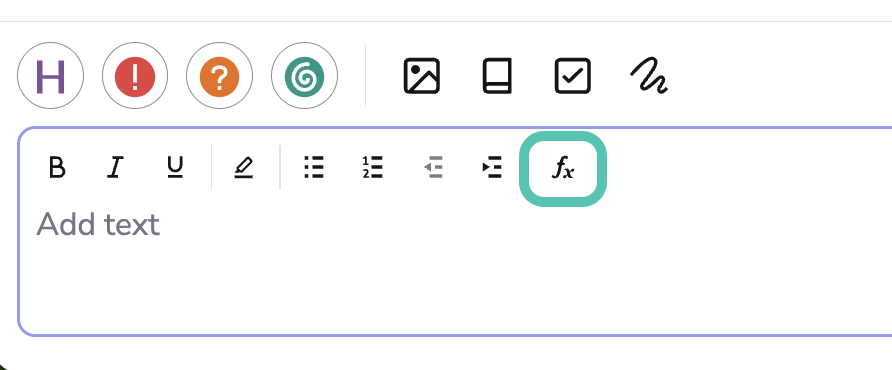
Click the formula icon in any of the text boxes
(Or if you already have a formula, you can click that to edit it)
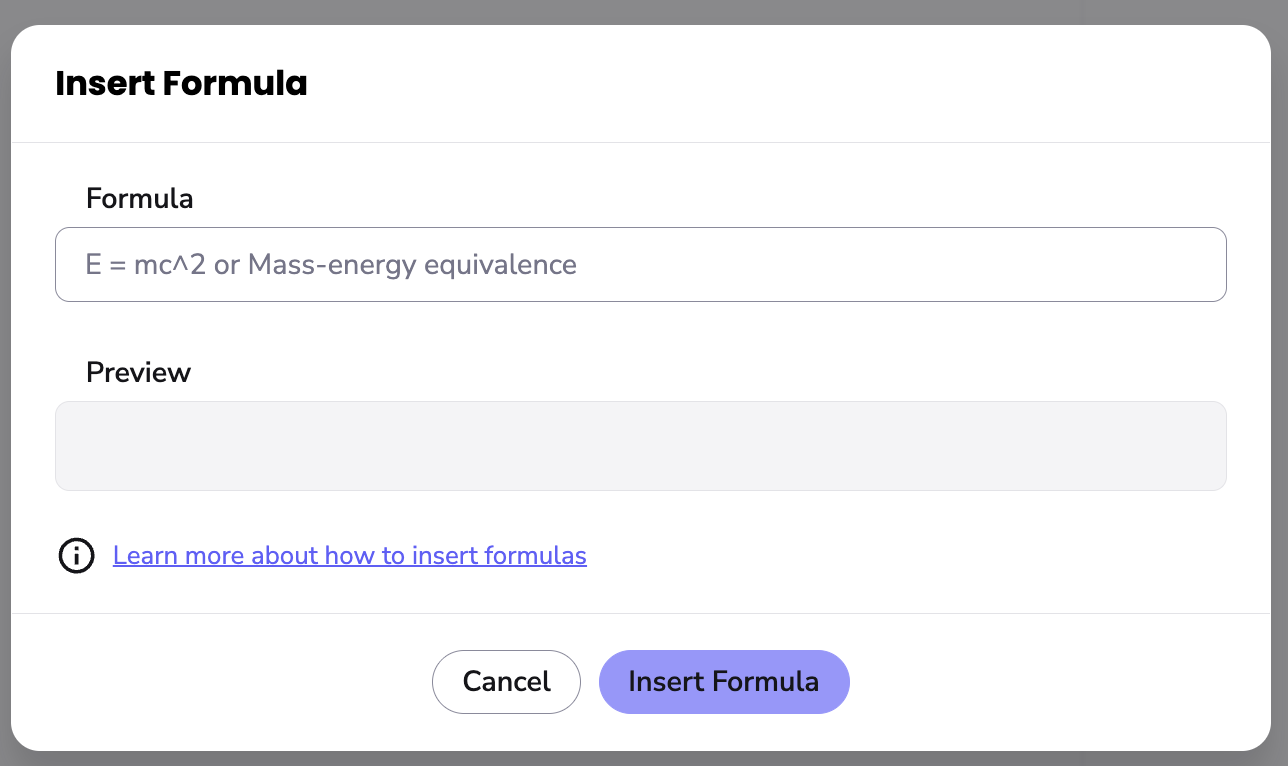
Then you'll see the Insert Formula pop-up tab:
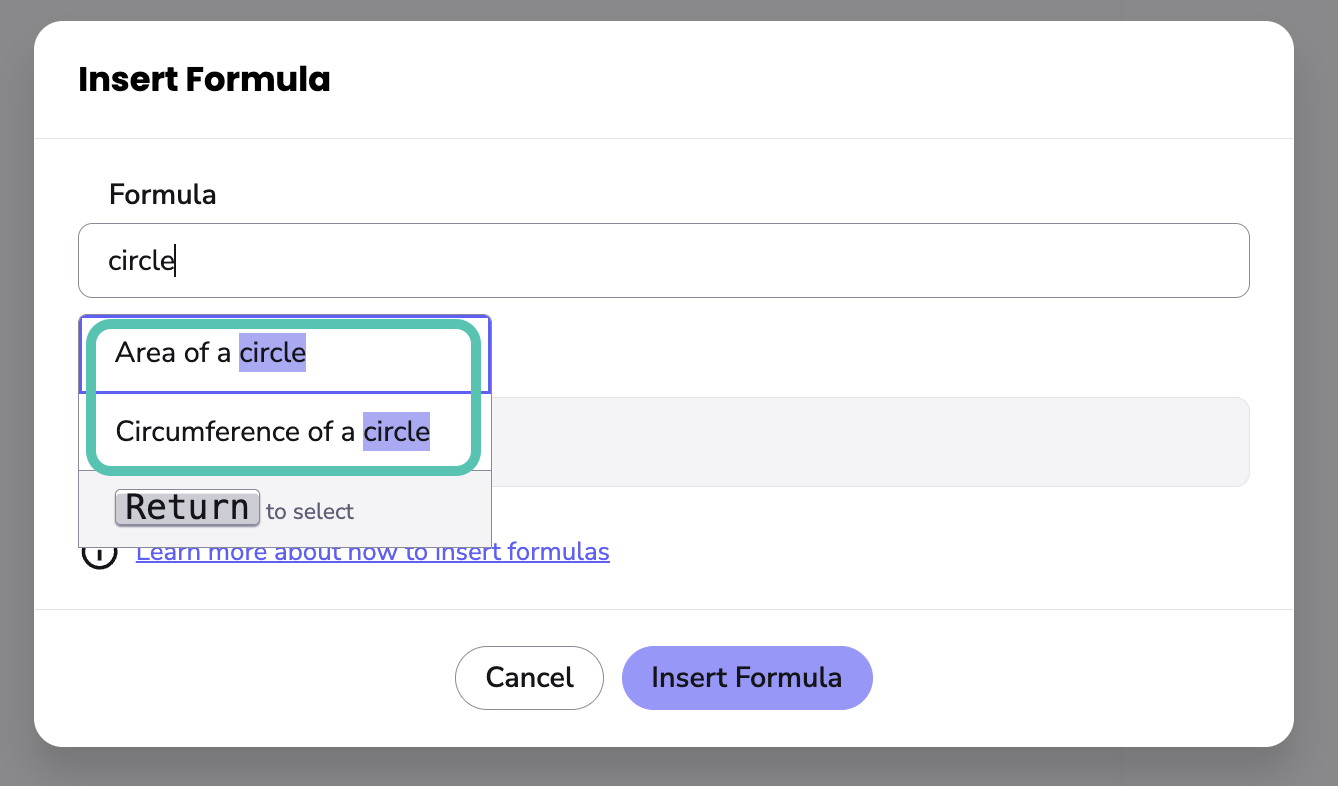
Search for a formula by name
No KaTeX? No problem. Start typing the name of an equation, like "circle" or "quadratic", and Genio will show you a list of matching equations to choose from.
Press Return or click one to drop the correct formula straight in:
Genio Notes currently covers 109 common Maths, Chemistry, and Physics equations:
Algebra (12)
- Quadratic formula
- Discriminant
- Vertex form of a parabola
- Vertex x-coordinate of a parabola
- Slope-intercept form of a line
- Point-slope form of a line
- Slope formula
- Difference of squares
- Sum of cubes
- Difference of cubes
- Change of base formula
- Product rule for logarithms
Geometry (18)
- Pythagorean theorem
- Area of a circle
- Circumference of a circle
- Distance formula
- Area of a triangle
- Heron's formula
- Area of a rectangle
- Area of a trapezoid
- Area of a parallelogram
- Volume of a sphere
- Surface area of a sphere
- Volume of a cylinder
- Surface area of a cylinder
- Volume of a cone
- Volume of a cube
- Volume of a rectangular prism
- Surface area of a cube
- Sum of interior angles of a polygon
Trigonometry (10)
- Pythagorean identity
- Law of sines
- Law of cosines
- Tangent identity
- Double angle formula for sine
- Double angle formula for cosine
- Angle sum formula for sine
- Angle sum formula for cosine
- Euler's formula
- Euler's identity
Calculus (10)
- Derivative definition
- Power rule
- Product rule (derivatives)
- Quotient rule
- Chain rule
- Integration by parts
- Fundamental theorem of calculus
- Taylor series
- Sum of an infinite geometric series
- Mean value theorem
Linear algebra (4)
- Determinant of a 2x2 matrix
- Dot product
- Cross product magnitude
- Eigenvalue equation
Physics (30)
- Newton's second law
- Newton's law of universal gravitation
- Mass-energy equivalence
- Kinetic energy
- Gravitational potential energy
- Work
- Power (physics)
- Momentum
- Impulse
- Ohm's law
- Electric power
- Coulomb's law
- Wave speed
- Frequency-period relation
- Snell's law
- Kinematic equation for velocity
- Kinematic equation for position
- Kinematic equation for velocity squared
- Centripetal acceleration
- Angular velocity
- Density
- Pressure
- Hooke's law
- Period of a pendulum
- Period of a spring-mass system
- Stefan-Boltzmann law
- Planck's relation
- De Broglie wavelength
- Schwarzschild radius
- Time dilation
Chemistry (5)
- Ideal gas law
- Molarity
- pH equation
- Arrhenius equation
- Dilution equation
Statistics and probability (12)
- Standard deviation
- Variance
- Mean
- Combinations
- Binomial theorem
- Permutations
- Bayes' theorem
- Normal distribution
- Z-score
- Expected value
- Correlation coefficient
- Linear regression slope
Finance (4)
- Compound interest
- Simple interest
- Present value
- Future value of an annuity
Number theory and series (4)
- Sum of an arithmetic series
- Sum of the first n natural numbers
- Sum of the first n squares
- Binet's formula for the Fibonacci sequence
Prefer to type the KaTeX yourself? You still can (see below). Searching by name is just a quick option alongside it, not a replacement.
What functions can I use?
You can use any of the functions supported by KaTeX. See here for the full list of functions: https://katex.org/docs/supported
You can enter Chemistry Elements and Physical Units using our mhchem integration. See here for a full guide on what's supported: https://mhchem.github.io/MathJax-mhchem/
Help!
To create a formula, you'll need to use specific letters and symbols to give structured instructions on how to build the formula. Think of it like writing a simple recipe, where every symbol tells the system exactly what to do. See our examples below.
Basic Symbols: x y 1234 + - = etc can all be used to build out formula
Functions: More advanced functions have an abbreviated name and you'll need to add a forward slash at the start so we know this is a function rather than a list of letters. For example: \sqrt \frac \rightarrow \sum etc
Curly brackets: To separate different functions or to specify exactly what is captured by a function use curly brackets. For example: \frac {top} {bottom}
Examples
Powers
To enter powers you'll need to add the ^ icon; this is usually SHIFT+6 on your keyboard

Try it yourself: e=mc^2
To add powers with multiple digits you need to use curly brackets to let us know what's the power and what's not.

Try it yourself: x^{69}
What happens if you don't use the curly brackets?
Roots
Sometimes a symbol isn't enough to tell KaTeX what you need, so you'll need to use a named function. Eg "sqrt" for a square root, or "frac" for a fraction. To use these functions you need to add a forward slash first so we know it's a function and then add your content in between curly brackets.
To add a square root:

Try it yourself: \sqrt{2ac}
What happens if you don't use the curly brackets?
To add a different root use square brackets to add the root you want:

Try it yourself: \sqrt[3]{2ac}
Fractions
To build a nice looking fraction use the \frac function with curly brackets around your numerator {the top} and the denominator {the bottom}

Try it yourself: \frac {top} {bottom}
The Result
And then combine them all into something you'll hopefully recognise:

Try it yourself: x = \frac { -b ( \pm { \sqrt{b^2-4ac}}) }{2a}

Chemistry Elements
To enter chemistry elements begin with \ce and add your content inside curly brackets.
(https://mhchem.github.io/MathJax-mhchem/)

Try it yourself: \ce{SO3 + H2O -> H2SO4}
Physical Units
To enter physical units begin with \pu and add your content inside curly brackets:
(https://mhchem.github.io/MathJax-mhchem/)

Try it yourself: \pu{2.16E-7 m/s2}